
I spent three hours staring at a blinking cursor in the Google Business Profile dashboard five years ago, convinced I was some kind of marketing genius. I had selected five different, high-volume categories for a local contractor, thinking I was casting a wide net that would catch every homeowner in the tri-state area. I was wrong. Dead wrong. Within a week, his rankings plummeted from the top three to somewhere on page five where nobody—and I mean nobody—ever goes. I learned the hard way that when you try to be everything, the map decides you’re nothing. It’s like trying to tell a stranger you’re a brain surgeon, a plumber, and a jazz pianist all at once; they won’t hire you for any of it because they simply don’t trust you. [image_placeholder] Today, we’re going to fix that “category cannibalization” and get your profile back on top by teaching you how to stop your categories from fighting for dominance.
The Day I Accidentally Nuked a Client’s Visibility
It was a classic rookie move, the kind I look back on now and wince at. I thought adding ‘General Contractor’ alongside ‘Roofing’ and ‘Kitchen Remodeling’ would help us show up in every possible search. Instead, Google’s AI looked at the profile, got confused by the broadness, and threw its hands up in the air. This is a common issue my google map experts and I see every single week when we audit new accounts. If your primary category doesn’t align perfectly with your most important services and your website content, you’re essentially shouting into a void. I remember the client calling me, frantic, because his phone had stopped ringing entirely during what should have been his busiest season. It took us weeks of careful pruning to recover that ground.
One Wrong Choice Can Silence Your Phone
You might think you’re helping yourself by being thorough, but there’s a delicate balance to how to use secondary categories without confusing the algorithm. According to research from Whitespark, the primary category remains the single most influential ranking factor for the local pack, meaning a mistake here can override even the most expensive visibility improvement moves you’ve made. When your categories fight, the only winner is the competitor down the street who kept things simple.
Is picking just one main category actually worth the risk?
You’re probably worried that by narrowing your focus, you’ll miss out on leads from those “side” services. I get it. It feels counterintuitive to leave money on the table. But here’s the cold, hard truth: Google rewards relevance over volume every single time. If you’ve noticed your profile views are high but your phone isn’t ringing, you’re likely suffering from a lack of categorical focus. Check out this simple change to your secondary categories to see how focus actually drives growth. Have you ever noticed your ranking drop right after you “optimized” your category list? It’s a frustrating spot to be in, but we can fix it together.To start, you need to treat your business category like a high-performance engine. If you throw in five different types of fuel, the machine stalls. I recently consulted for a local dental practice that was ‘optimizing’ themselves into oblivion. They had selected ‘Dentist,’ ‘Cosmetic Dentist,’ ‘Dental Implants Periodontist,’ and ‘Emergency Dental Service’ all as primary-level interests. The result? They weren’t ranking for any of them. We sat down and made one difficult choice: ‘Dentist’ became the primary, and the rest were relegated to secondary status. Within 14 days, they jumped from the second page to the local three-pack for their most profitable ‘dental implants’ queries. This happens because of the one setting your maps optimization team needs to change fast: the singular focus of your primary category signal.
Stop Cramming Your Profile with Irrelevant Labels
Every extra category you add that doesn’t directly describe your core business dilutes your authority. Think of Google as a librarian with only ten seconds to shelve your book. If you tell her the book is about cooking, car repair, and 18th-century poetry, she’s going to leave it in the ‘misc’ pile. This ‘misc’ pile is where rankings go to die. When my google map experts audit a profile, the first thing we do is prune. We look for ‘category bleed’ where businesses try to capture adjacent traffic. If you are a plumber, don’t list ‘hvac contractor’ unless you actually have a separate team and dedicated landing pages for it. This mismatch is a major reason why your business profile views are high but leads are low.
Pick One Primary Category or Risk Losing It All
Your primary category is the anchor. It’s the heavy weight that keeps your map pin from drifting away when the algorithm shifts. You must choose the category that represents about 80% of your revenue or your most desired customer. If you’re a personal injury lawyer but you also do occasional wills, your primary must be ‘Personal Injury Attorney.’ Do not waver. We follow the exact steps we use for rapid visibility improvement by cross-referencing your choice with what the top three competitors in your city are using. If they are all using a specific term and you aren’t, you’re playing a game with different rules.
Sync Your Website to Your Map Pin Immediately
Google doesn’t just look at your dashboard; it crawls your site to verify your claims. This is the signal chain that connects your site to your map pin. If your GBP says you are a ‘Roofing Contractor’ but your website homepage is a generic ‘Home Improvement’ wall of text, the algorithm smells a lack of expertise. You need to use how to use targeted local content to fuel your map profile by ensuring your H1 tags and your primary GBP category are mirrors of each other. When these two data points align, your ‘trust score’ with the local algorithm skyrockets, making it much harder for a competitor to nudge you out of your spot.But here’s where most people get it wrong: they think trust is a one-time setup. It’s not. Most people assume that if they just get enough five-star reviews, Google will eventually hand them the keys to the city. That is a dangerous half-truth. In my experience, I have seen profiles with 50 reviews outrank competitors with 500 because the smaller profile had better keyword-rich sentiment. This is why the review request mistake that costs you half your leads is so devastating—it focuses on quantity over quality. According to the 2024 Whitespark Local Search Ranking Factors study, review sentiment and keywords in reviews now carry significantly more weight than the raw number of stars. If your reviews don’t mention your specific services, Google doesn’t know what you’re an expert in.
Why does a competitor with ten reviews sit above your hundred?
It usually comes down to what we call ‘real-world interaction signals.’ Google tracks how many people click for directions, call your number, or spend time reading your posts. If your maps optimization team isn’t focusing on these behavioral triggers, you’re just spinning your wheels. I’ve watched google map experts fail because they ignored how often a user actually interacts with the profile after finding it. It’s about the ‘dwell time’ on your profile, similar to how it works on a website. 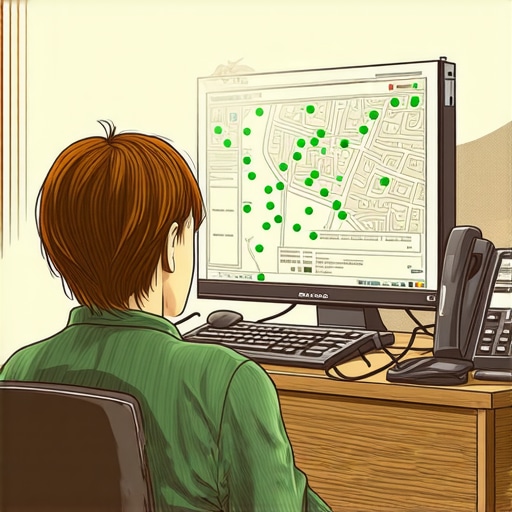
Spotting the red flags in your ranking reports
Another massive trap is relying on those fancy ‘heat map’ reports that show you ranking #1 everywhere. Many of those are generated from static IPs or don’t account for mobile variance. This is exactly how to spot a fake map ranking report from your agency before you waste another month’s retainer. If your reports look too good to be true but your phone is silent, they probably are. True visibility improvement moves are measured by lead volume, not just colorful dots on a map. I have seen businesses celebrate being #1 for a term no one actually searches for. It’s a classic misdirection. People often ask for local visibility help and receive outdated tactics like citation blasting or keyword stuffing in descriptions, which simply doesn’t move the needle anymore.
The proximity trap that kills growth
Everyone tells you to focus on your immediate five-mile radius, but the real growth happens when you learn the secret to ranking in neighboring zip codes safely. Most businesses hit a ‘proximity ceiling’ because they don’t understand how to bridge the gap between their physical location and the surrounding high-value neighborhoods. They keep optimizing for their own backyard while their competitors are stealing the premium leads from two miles over. This requires a level of the one signal visibility experts use to beat multi-location firms: localized entity relevance. It is a deep-dive topic, but getting it wrong means you’re stuck in a small pond forever. Have you ever fallen into this trap? Let me know in the comments.
Stop Letting Your Rankings Rot on the Vine
Maintaining that top spot isn’t a ‘set it and forget it’ situation. I’ve seen businesses climb to number one, celebrate with a steak dinner, and then completely ignore their profile for three months, only to find themselves buried under a pile of more aggressive competitors. If you aren’t actively protecting your territory, you are losing it. Every week, I set aside twenty minutes to perform a manual check because even the best google map experts know that the algorithm never sleeps. You need a defensive strategy that identifies shifts before they become disasters.
Ditch the Guesswork and Use My Personal Toolkit
I don’t rely on generic ‘rank trackers’ that only give me a snapshot from one zip code. I need to know exactly how to snoop on competitor map data to steal their best traffic in real-time. My go-to tool for this is the PlePer Chrome extension; it lets me see the exact secondary categories my rivals are using without me having to dig through source code. If you’re on a budget, you can still learn how to audit your local map presence without expensive tools by using a mobile device at different physical locations to see how your ‘bubble’ expands or contracts. According to Joy Hawkins at Sterling Sky, recent data suggests that the ‘Open Now’ filter is becoming an increasingly heavy weight in the ranking algorithm, meaning if your hours are inaccurate, you’re effectively invisible during peak search times. #IMAGE_PLACE_HOLDER_D#
How do I keep my map rankings steady every month?
The secret to long-term stability is consistency in your ‘engagement signals.’ Don’t just post five photos today and then go silent for a month. I recommend a rhythmic approach: one high-quality, geo-tagged photo and one Q&A response per week. This creates a heartbeat for your profile that tells the algorithm you are still an active, reliable business. This is part of the map optimization checklist for service area businesses that I give to every one of my private clients.
The Future is Coming for Your Map Pin
We are moving toward a world where AI doesn’t just show a list of pins; it provides ‘AI Overviews’ that summarize why a business is the best choice. This makes the secret to staying on the map when the algorithm shifts more about your ‘entity authority’ than just your proximity. In the next 18 months, I predict that voice-activated searches from car dashboards and smart watches will account for over 60% of local discovery. You need to prepare now by learning how to optimize your business profile for voice searchers who use conversational language like ‘find a plumber near me who is open now.’ Your map pin isn’t just a dot; it’s the digital front door to your livelihood. Tonight, I want you to download a free category auditor extension and check if your top competitor is using a ‘hidden’ secondary category that you’ve been ignoring. One simple switch could be the difference between a silent phone and a packed schedule.
Hard Truths from My Years in the Local Map Trenches
After auditing hundreds of profiles, I’ve realized that the biggest enemy of a maps optimization team isn’t a competitor—it’s the business owner’s desire to be “everything to everyone.” You have to embrace the power of exclusion. If you try to rank for 20 categories, you will effectively rank for zero. I’ve seen this time and again: the simple move to fix your flatlined map impressions often starts with deleting half of your secondary categories. Also, remember that your website is the silent witness to your GBP; if they don’t match, Google won’t trust you.
- Your primary category is your identity, not a wish list.
- Reviews that mention specific services carry more weight than 100 generic “great job” comments.
- Consistency in updates tells the AI your business is “alive.”
[image_placeholder]
The Gear and Guides That Actually Move the Needle
I don’t expect you to do this blindly. To get the best results, you need reliable data and a solid visibility improvement plan. Here is the toolkit I use daily to stay ahead of the curve:
- PlePer Chrome Extension: This is my “X-ray vision” for spying on competitor categories. It is an essential tool for any serious google map experts looking for an edge.
- Whitespark’s Annual Survey: Think of this as the bible of local search. It separates what actually matters from the marketing fluff.
- The Service Area Checklist: If you don’t have a physical storefront, you need the map optimization checklist for service area businesses to ensure your radius isn’t accidentally killing your reach.
Your Future on the Three-Pack Starts Tonight
The local map landscape is getting more crowded, but it’s also getting smarter. By focusing on relevance and user trust, you are positioning yourself for long-term local visibility help that survives any algorithm shift. Don’t wait until your phone stops ringing to check your settings. Follow expert map optimization strategies for 2025 and start reclaiming your territory today. Every small adjustment you make now is a signal that tells Google you are the most trustworthy authority in your neighborhood.
Have you ever noticed your ranking drop immediately after you changed your business categories? I’d love to hear about your experience in the comments below.