
I’ll never forget the Tuesday I sat in my home office, staring at a Google Business Profile dashboard that looked like a gold mine. I had over 6,000 views in thirty days. On paper, I was winning. But when I looked at my call log, it was a ghost town. My actual leads were essentially zero. I felt like a failure who had been sold a dream that just didn’t hold up in the real world. It was a brutal realization that why your business profile views don’t lead to sales often has nothing to do with how many people see you, and everything to do with what they see when they arrive. Today, we are going to bridge that gap between ‘being seen’ and ‘getting paid’ so you can finally stop staring at meaningless graphs and start answering the phone.
Stop Chasing Ghost Traffic that Never Converts
I made the classic mistake early on of thinking that as long as I was in the ‘Three-Pack,’ the money would follow. I obsessed over keywords and technical tweaks, but I ignored the human psychology of a local searcher. If your profile looks like a generic template, people will scroll right past you to a competitor who looks like a real person they can trust. This is exactly why local visibility help is sometimes more about personality than it is about purely technical rankings. According to a study by BrightLocal, 87% of consumers used Google to evaluate local businesses in 2022, which means your profile is your first—and often only—chance to make a handshake. If that handshake feels cold and robotic, they are gone in a heartbeat.
Is This High View Count Just a Vanity Metric?
You might be wondering if those thousands of views are even real people or just bots crawling the web. While most are real human beings, they are ‘window shoppers’ who aren’t finding a compelling reason to stop. If you aren’t showing off the right visuals or responding to inquiries, you might be falling for the review request mistake that costs you half your leads by not having recent, authentic social proof that speaks to their specific pain points. Your maps optimization team should be focusing on conversion signals, not just raw impressions. Have you ever felt the sting of seeing your ‘Performance’ tab go up while your bank account stays the same? It’s frustrating, but it’s a fixable problem that starts with shifting your focus from the algorithm back to the customer.
Stop Hiding Behind Boring Stock Photos
The first thing I look at during a 5-hidden-errors-in-your-profile-audit is the photo gallery. If it is filled with generic people in suits holding clipboards, you have already lost. Think of your photos like the front window of a physical shop. If the window is boarded up or shows something totally unrelated to the inside, nobody is walking in. I remember working with a local HVAC technician who had beautiful, professional stock images. His impressions were through the roof, but his ‘Request a Quote’ button was gathering dust. We spent twenty minutes on a job site taking ‘ugly’ photos of him covered in soot, smiling next to a repaired furnace. Within 48 hours, he had three new leads. Those real images were the exact photo strategy that triggers local search signals because Google—and more importantly, humans—could see he was the real deal.

Pick a Category That Actually Describes What You Do
Many business owners pick the broadest category possible, thinking it will help them show up for everything. It is like a specialized heart surgeon labeling themselves as a ‘Human Doctor.’ You might get more broad traffic, but you will not get the patients who need surgery. If you are a specialized boutique, do not just pick ‘Clothing Store.’ This mistake is a primary reason why your business category might be killing your visibility. You need to be specific. When I helped a local bakery switch from ‘Store’ to ‘Wedding Bakery,’ their visibility in the surrounding five miles tripled because they finally stopped competing with big chains for general searches. Professional visibility experts will tell you that niche relevance beats broad reach every single time.
Use Google Posts to Answer Questions Before They Are Asked
Most people treat Google Posts like a secondary Facebook feed, but it is actually a conversion engine. You are not just posting updates; you are removing the friction that prevents a phone call. Use these posts to highlight your unique selling points or to address common objections. If you show exactly how to use google posts to drive more storefront traffic, you will realize that a post about ‘Free Parking in the Rear’ or ‘Weekend Availability’ can be the difference between someone visiting you or your competitor. Your maps optimization team should be cycling these weekly to keep the profile fresh and relevant to current consumer needs.
Build a Trust Engine with the Q&A Section
Do not wait for customers to ask questions—ask them yourself. I often tell my clients to treat the Q&A section like an FAQ page on steroids. When you seed your own questions and provide helpful, detailed answers, you are essentially creating a tool for visibility improvement that lives directly on your profile. I once saw a law firm double their consultation requests simply by answering the question, ‘Do you offer free initial consultations?’ prominently in their Q&A. It sounds simple, but it removes the ‘Is this worth my time?’ barrier immediately and signals to Google that your profile is highly interactive and useful for searchers in your local area.
Let’s dig deeper. Most self-proclaimed google map experts will tell you that the number of reviews you have is the single most important factor for ranking. I’m here to tell you that is a massive oversimplification. In fact, if you focus solely on volume, you are missing the forest for the trees. According to the 2023 Local Search Ranking Factors study by Whitespark, review ‘sentiment’ and the inclusion of specific keywords within those reviews carry significantly more weight than just having a high count. This explains why your competitor with fewer reviews is ranking higher than you. They aren’t just getting ‘good’ reviews; they are getting descriptive ones that tell Google exactly what services they provide.
More Reviews Won’t Save a Broken Profile
I’ve seen businesses with 500 reviews get outranked by a shop with 50 because the latter had better ‘velocity’—a steady stream of new feedback rather than a burst of reviews three years ago. If your maps optimization team isn’t talking about review recency and keyword density, they are stuck in 2015. Real visibility improvement happens when you treat reviews as a data source for the algorithm, not just a trophy case.
How to Spot a Ranking Report That Is Pure Fiction
This is the ‘Oops’ factor that drains marketing budgets. Many agencies use tools that generate ‘geogrid’ reports—those maps with green and red dots showing where you rank. The trap is that they often set the search parameters so narrowly (like searching for your exact business name rather than a service) that they show you a sea of green that doesn’t exist for a real customer. If you don’t know how to spot a fake map ranking report from your agency, you might think you’re dominating the city while your phone remains silent. Real visibility experts show you rankings for ‘unbranded’ terms—the things people search for when they don’t know you exist yet. 
Can You Really Beat the Proximity Filter in 2025?
Advanced readers often ask if it’s even possible to rank in a neighborhood five miles away when a competitor is sitting right there. The answer is yes, but it requires more than just a good profile; it requires deep-level technical authority. This is where the schema technicality most agencies skip for local dominance comes into play. By hard-coding your service areas into your website’s hidden data, you can extend your ‘relevance radius’ far beyond your physical front door. When you combine this with expert map optimization strategies for 2025, you start to see growth that defies the ‘proximity is king’ rule. If you aren’t seeing these results, it’s likely because you’ve focused on the technical tweaks without addressing the underlying trust signals Google requires. Have you ever fallen into this trap of chasing vanity metrics while ignoring the technical backbone? Let me know in the comments. For those who need more hands-on local visibility help, the benefit of using a professional map optimization team is that they look at these hidden signals every single day.
I’ve seen it happen dozens of times: a business hits the top three, celebrates with a steak dinner, and then ignores their profile for six months. By the time they realize their phone has gone silent, they’ve dropped to page four. The truth is that Google’s local algorithm is a living, breathing thing. You can’t just ‘finish’ your SEO. Real visibility experts know that staying on top is often harder than getting there. This is why your map listing needs regular updates to stay relevant; without a steady stream of new data, Google assumes your business is either stagnant or closed.
How can I keep my map ranking high month after month?
The secret isn’t just posting for the sake of posting. It’s about maintaining a rhythm of ‘signals.’ I personally use a tool called Local Falcon to track my progress. Unlike the vanity reports I mentioned earlier, this provides a geogrid that shows exactly where my ranking drops off—literally block by block. If I see a red dot in a neighborhood I should be winning, I know I need to increase my local relevance in that specific area. This is the only way to avoid the panic that comes when you need to figure out how to handle a sudden drop in map impressions. My maps optimization team spends at least an hour a week analyzing these grids to see where competitors are gaining ground. If you want to stay ahead, you have to learn how to snoop on competitor map data to steal their best traffic by looking at their review velocity and photo updates.
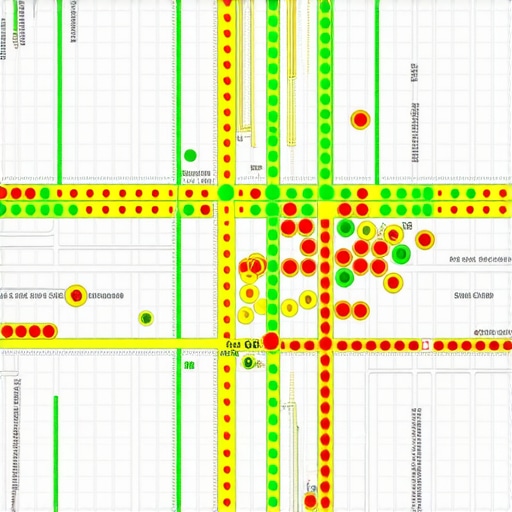
Tools that actually tell you the truth
Beyond geogrids, I swear by the ‘GMB Everywhere’ Chrome extension. It allows you to see the categories your competitors are using without digging through source code. When I’m providing local visibility help, this is the first thing I check. If a competitor suddenly jumps over you, they might have added a secondary category that you’re missing. Another specific tactic I recommend is using Google’s Cloud Vision API to ‘read’ your photos before you upload them. Niche expert Joy Hawkins from Sterling Sky has noted that Google’s AI is getting incredibly good at identifying objects within images. If you’re a plumber, your photos should clearly show pipes, wrenches, and trucks—not just your logo. This is a core part of the expert map optimization strategies for 2025 that focus on visual entity recognition.
The coming era of visual and AI search
Looking forward, the trend is moving toward ‘Search Generative Experience’ (SGE). Google is going to start summarizing your business for customers before they even click your profile. This means your visibility improvement efforts need to focus on being the ‘authoritative answer’ in your area. If your profile and website don’t clearly communicate your expertise, the AI will simply skip you. I predict that within two years, the ‘near me’ search will be almost entirely voice and visual. People will point their phone camera at a street and ask, ‘Which of these places has the best lunch special?’ If your photos aren’t optimized for that level of recognition, you’ll be invisible. I strongly encourage you to try running a geogrid search on your primary keyword today to see where you actually stand. Don’t wait until the phone stops ringing to start caring about your maps optimization team‘s performance.
Why “More” is Usually the Wrong Goal for Your Map Pin
One of the biggest shifts I had to make was realizing that visibility improvement isn’t a vanity contest. I used to think that ranking #1 for every keyword was the only thing that mattered. In reality, I learned that a business ranking #3 with a profile that actually answers questions will out-convert a boring #1 listing every single day. If you are struggling with your reach, you might need to learn how to fix the invisible radius problem for your local store to ensure you’re appearing for the right intent-driven searches.
Another hard lesson? You cannot “set it and forget it.” I’ve seen google map experts get lazy, thinking once a profile is optimized, the work is done. But the moment you stop feeding Google new data—photos, updates, or Q&As—your relevance starts to decay. If you want to stay on top, you need to know how to rank in the three-pack for competitive keywords by being the most active and helpful resource in your area. Your maps optimization team should be looking at engagement, not just positions.
My Go-To Tools for Staying Ahead of the Algorithm
To keep my clients at the top, I rely on a few specific resources that go beyond the basic dashboard. First, I use Local Falcon; it’s the only way to see the truth about your geographic reach without guessing. Second, I constantly monitor the Sterling Sky blog. They are the visibility experts who often catch algorithm shifts weeks before they are officially announced. Third, the GMB Everywhere extension is my secret weapon for seeing which categories are actually driving results for competitors. Finally, for those experiencing technical glitches, knowing how to handle a sudden drop in map impressions is vital to prevent long-term revenue loss.
Take the First Step Toward Dominating Your Neighborhood
The world of local search is only getting more competitive, especially as AI begins to summarize your business for potential customers. Don’t let your business get left behind because of a technicality or a lack of engagement. Whether you do it yourself or seek local visibility help, the key is to start moving today. If you’re feeling overwhelmed, remember the benefit of using a professional map optimization team is that they handle the complex shifts so you can focus on running your business. Your local community is looking for you; make sure they can find you and trust what they see.
Have you ever noticed your ranking drop suddenly after making a small change to your profile? Let me know in the comments below!