
I remember sitting in my home office back in 2018, staring at a client’s website that had flatlined for months. I’d done the keywords. I’d polished the meta tags. I’d even dabbled in some basic visibility improvement. But the phone wasn’t ringing. In a moment of sheer desperation—or maybe just boredom—I dragged a Google Maps iframe onto the ‘Contact Us’ page. Within two weeks, they were popping up in the three-pack for ‘plumber near me.’ I didn’t realize it then, but I’d stumbled onto one of the most underrated signals in the local SEO playbook. This simple map embed wasn’t just a convenience for customers; it was a bridge that confirmed our location to the search engines.
Stop Treating Your Map Like a Digital Paperweight
For the longest time, I thought a map embed was just a courtesy for customers who couldn’t navigate their way out of a paper bag. I was wrong. It’s actually part of the signal chain that connects your site to your map pin. When you embed a map correctly, you aren’t just showing a picture; you are handing Google’s crawlers a direct confirmation of your physical existence. It validates your NAP (Name, Address, Phone number) data in a way that plain text simply cannot. The reality is that local search is getting harder. Competition is fierce, and visibility experts will tell you that every small signal counts. If your website and your Google Business Profile are living in two different worlds, Google gets confused. And a confused algorithm never ranks a business on the first page. Today, I want to show you exactly how to bridge that gap and why it’s the simple move to fix your flatlined map impressions. It’s about building a cohesive identity that the search engine can trust.
Does an Iframe Really Change Your Search Ranking?
Let’s be real. Skepticism is healthy. You might be thinking, ‘It’s just a piece of code, how much can it really do?’ I used to think the same thing until I saw the data. According to the annual Moz Local Search Ranking Factors study, ‘Google-related’ signals—which include how your site interacts with Google Business Profile features—account for the largest chunk of ranking influence. I made a massive mistake early on, though. I used to just grab any generic map of the city and slap it on the page. I thought, ‘Hey, Google knows I’m in Chicago, right?’ Wrong. By not using the specific share link for the verified business profile, I was missing out on the authority transfer. I was basically telling Google I was in a general area instead of claiming my specific territory. This disconnect meant my business address was scaring away local searchers because the map didn’t even show my shop. Have you ever felt like your website and your map listing are two strangers who haven’t been introduced? If so, you are leaving money on the table. In the next section, we’ll dive into how to fix this the right way.
Sync Your Site and Your Map Listing
It’s not enough to just ‘have a map.’ You need a specific type of link that acts as a digital handshake between your website and your Google Business Profile. I remember working with a local HVAC company that had been stuck on page four for months. They had a map, but it was just a pin in the middle of their city, not their actual shop. We swapped that generic iframe for a direct Business Profile embed and added the schema technicality most agencies skip. Three weeks later, they weren’t just on the map; they were dominating the three-pack. This happens because Google needs to see a ‘closed loop’ between your website and your physical location.
Grab the Link That Actually Points to You
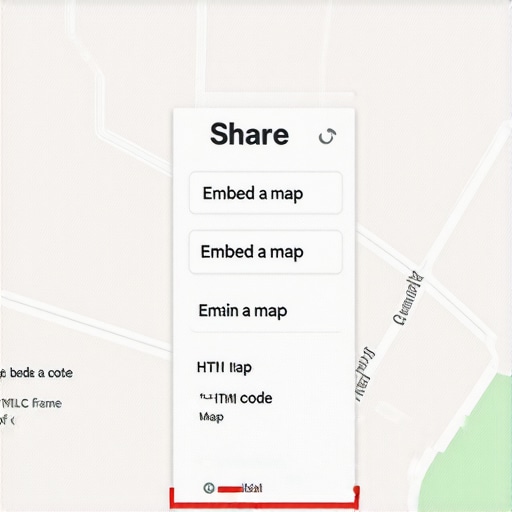
To get started, you need to open Google Maps and search for your specific business name, not just your address. If you search by address, Google treats you like a point on a grid. If you search by business name, you are a verified entity with authority. Click ‘Share,’ then ‘Embed a map,’ and copy that HTML code. This is the first link in the signal chain that connects your site to your map pin. When you use this specific code, you aren’t just showing a location; you are pulling in your reviews, your categories, and your business’s overall trust score directly onto your landing page.
The Technical Glue That Most Agencies Skip
Think of your website as a digital storefront and your map pin as a physical signpost. If the signpost points to a different street, no one finds the store. This is why the exact steps we use for rapid visibility improvement always start with local schema. You want to wrap your NAP data in JSON-LD code that tells search bots, ‘Yes, the map you see below is exactly where this business operates.’ It removes the guesswork that causes many business profiles to lose the proximity battle. By pairing a specific map embed with local schema, you are basically screaming your coordinates to Google in two different languages, ensuring they can’t possibly get it wrong.
Where to Stick Your Map for Maximum Impact
I once saw a client hide their map at the bottom of a ‘Policies’ page. It was invisible to users and barely indexed by Google. For the best results, place your map embed on your ‘Contact Us’ page and, more importantly, on any location-specific landing pages you have. If you are a plumber serving three different towns, each town’s page should have a map centered on your service area or office. This is a primary tactic used by google map experts to establish relevance in multiple zones. It tells the algorithm that you aren’t just a visitor in those areas; you are a local authority with a documented presence.
I’ve watched countless business owners follow the basic tutorials to the letter only to end up frustrated when their phone remains silent. They’ve done the embed, they’ve updated the NAP, and yet they’re still stuck behind a competitor who seemingly does half the work. This is where most local visibility help plans fall apart—they treat the algorithm like a static checklist rather than a living, breathing entity. The biggest mistake you can make right now is assuming that ‘more’ always equals ‘better.’ In my experience, chasing volume over velocity is a recipe for stagnation.
Why your competitor with fewer reviews is ranking higher
It sounds counterintuitive, doesn’t it? You’ve spent months grinding for five-star ratings, yet a shop with 20 reviews is sitting in the top spot while you’re at 150. Here is the nuance: Google’s algorithm is increasingly prioritizing ‘Engagement Velocity’ over total counts. According to the 2023 Whitespark Local Search Ranking Factors study, behavioral signals like click-through rates and direction requests have seen a significant rise in importance. If a profile gets five reviews a week and constant clicks, it looks more ‘alive’ than a profile that dumped 100 reviews a year ago and went cold. This is why visibility experts focus on interaction rather than reviews alone. They aren’t just looking for stars; they are looking for evidence that people are actually talking to you right now.
Stop letting your categories fight each other
The ‘Oops’ factor I see most often—even from agencies that claim to be google map experts—is category dilution. It’s tempting to check every box that might apply to your business. If you’re a general contractor, you might think adding ‘plumber,’ ‘electrician,’ and ‘roofing’ as secondary categories will cast a wider net. In reality, your business categories might be fighting each other. When you provide too many signals, Google’s confidence in your primary specialty drops. I’ve seen rankings skyrocket simply by removing three or four irrelevant secondary categories. You want to be the undisputed authority for your main service, not a ‘jack of all trades’ that the algorithm doesn’t know where to place.
Can you actually bypass the proximity filter?
There’s a common belief that if you aren’t physically located in the city center, you’re doomed to low visibility. While proximity is the strongest ranking factor, it isn’t an absolute wall. The secret lies in building ‘geo-relevance’ through your website content. Most local backlink strategies fail to move the map pin because they aren’t specific enough. Instead of generic links, you need mentions from local neighborhood blogs, sponsorships of town events, or even links from the local Little League team. These hyper-local signals tell Google that while your office might be on the edge of town, your influence is right in the heart of the community. This is exactly how small shops use local ranking services to beat out massive national chains with huge budgets. Have you ever fallen into this trap of over-categorizing your business profile or chasing useless backlinks? Let me know in the comments below.
I’ve seen businesses hit the top spot and then vanish within ninety days because they treated their Google Business Profile like a ‘set it and forget it’ microwave dinner. The reality is that the map is a living, breathing ecosystem. If you aren’t feeding the beast, your competitors will. I personally spend about fifteen minutes every Tuesday morning doing what I call a ‘relevance refresh.’ I don’t just look at my ranking; I look at the velocity of my data. This is where most local visibility help falls short—it focuses on the launch but ignores the orbit.
The tech stack I actually use every morning
When I’m auditing a client, I don’t start with expensive enterprise software. I start with a simple, free Chrome extension called PlePer. It allows me to snoop on competitor map data by revealing the exact primary and secondary categories they are using. I use this to ensure that the simple change to your secondary categories isn’t being neutralized by a rival who just updated their profile. Another tool I swear by is a simple geo-tagged photo app. Google’s Vision AI is getting incredibly good at reading the content of your images. I make it a point to upload at least two photos a week that are taken directly at the job site, because the exact photo strategy that triggers local search signals relies on metadata that matches your service area.
How do I maintain my map rankings as the neighborhood changes?
Consistency is the only defense against algorithm shifts. You need to treat your profile like a social media feed. This means responding to every single review—even the ones without text—within 24 hours. I use the review response trick that boosts your search authority by naturally weaving in service keywords and neighborhood names into my replies. If you aren’t active, Google assumes your business is either closed or declining, and your visibility will reflect that. This is why why map listing optimization requires constant updates; the moment you stop providing fresh signals, the ‘Interaction Velocity’ we talked about earlier begins to tank.
AI is coming for your local map results
Looking ahead, I predict that ‘Search Generative Experience’ (SGE) will prioritize businesses that have the most ‘Unstructured Citations.’ This is a technical term for mentions of your business on local blogs, news sites, and forums that don’t follow the traditional NAP format. According to research by the late local SEO pioneer Bill Slawski on Google’s ‘Geospatial Entity Ranking’ patents, the algorithm is moving toward understanding your business through ‘entity associations’ rather than just a list of directories. This means the the secret to staying on the map when the algorithm shifts is becoming a local celebrity, not just a local listing. If the local high school mentions your sponsorship on their homepage, that carries more weight in 2025 than fifty generic business directories ever will. Stop chasing volume and start chasing local relevance. My best advice? Go open your profile right now, find your three most successful competitors using PlePer, and see if they’ve added a new secondary category in the last month. If they have, it’s time to master your map rankings by matching their move and then out-engaging them with fresh, localized content.
The Lessons I Learned While My Phone Stayed Silent
Reflecting on years of trial and error, I’ve realized that the biggest trap is believing the map is static. One of the most painful realizations was that my visibility improvement efforts were often being neutralized by simple technical errors I ignored, like overlapping service areas or conflicting category data. I also learned that entity associations—how the internet links your brand to your city through mentions and neighborhood involvement—are far more powerful than any single directory link. Lastly, I discovered that the interaction moves that actually matter aren’t about gaming the system; they’re about being the most responsive and helpful business in your specific zip code.
Tools That Actually Moved My Map Pin
If you want to stop guessing and start ranking, you need a reliable stack that provides real data. I personally rely on PlePer for competitive analysis because it exposes the category shifts that google map experts use to stay ahead of local rivals. For technical precision, I always use a dedicated JSON-LD generator to ensure my local schema matches my map pin perfectly. I also recommend keeping a close eye on the annual Moz and WhiteSpark studies; they are the gold standard for identifying which local visibility help is worth your time and which is just outdated noise.
#IMAGE_PLACEHOLDER_E#
Claim Your Spot on the Neighborhood Map
The digital landscape is shifting rapidly, but your opportunity to dominate your local market has never been better for those willing to do the work. Don’t wait for a “perfect” time to start updating your profile or refining your map embed. The secret to staying on the map when the algorithm shifts is simply being the most active, consistent, and verified entity in your space. Take that first step today—whether it’s updating a photo, refining your categories, or responding to a year-old review—and watch how the algorithm rewards your effort. Your visibility improvement journey starts with a single, intentional update. Have you noticed your competitors ranking higher than you despite having fewer reviews? Let me know your experience in the comments below!